.png)
From First Year to Job Ready: A College Roadmap for Career Skills

A degree can open the door, but skills help you walk through it with confidence. Many students wait until the final year to think about placements, resumes and interviews. By then, the gap between classroom learning and workplace expectations can feel too wide.
The better approach is to build career skills in small, steady steps from the first year of college. That means learning tools, doing projects, taking internships, building a portfolio, practising communication and staying aware of industry changes before placement season begins.
Students can become job-ready before graduation by combining academic knowledge with practical skills, projects, internships and industry exposure.
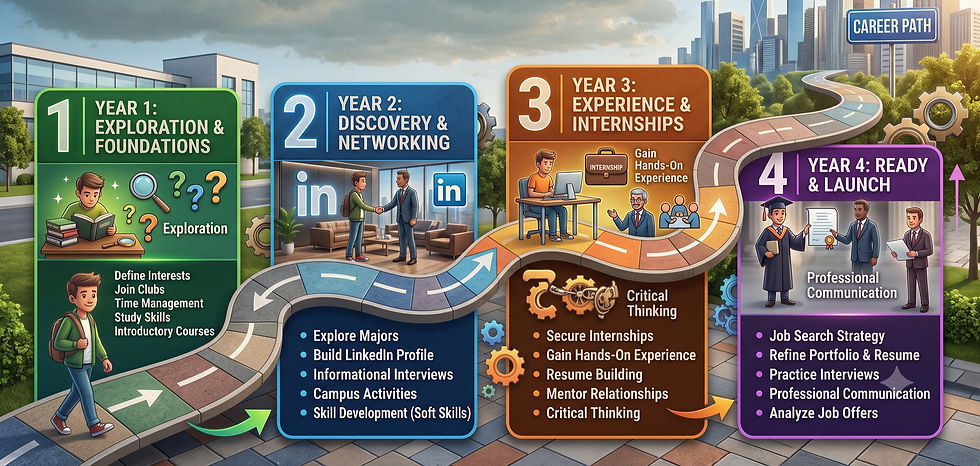
This roadmap is not a generic list of skills. It is a year-by-year action plan for becoming a job-ready graduate.
Start with the right mindset in the first year
The first year is not too early to think about careers. It is the best time to explore without pressure.
At this stage, the goal is not to decide your entire future. The goal is to understand what kind of work exists, what skills are in demand and what interests you enough to practise consistently.
Start with three questions:
What subjects do I enjoy enough to learn beyond the syllabus?
What roles sound interesting in my field?
What skills do those roles expect from fresh graduates?
For example, a commerce student may explore accounting tools, Excel, business analytics or financial reporting. A computer science student may explore coding, web development, app development, cloud basics or cyber security. A design student may explore Figma, user research, visual design and portfolio building.
The first year should build your learning habits. Spend a few hours each week on skill practice. Watch tutorials, take short courses, read job descriptions and speak to seniors. This simple routine helps you understand the difference between academic knowledge and workplace readiness.
First-year focus
What to build | What to do |
Career awareness | Read job descriptions for entry-level roles in your field |
Learning habit | Study one practical skill for 3 to 5 hours a week |
Basic digital ability | Learn spreadsheets, presentations and online collaboration tools |
Confidence | Join clubs, events, competitions or student communities |
Self-record | Keep a simple document of courses, projects and achievements |
This is also the right time to start building employability skills for students, such as time management, teamwork, curiosity and problem solving. These may sound basic, but they show up in every internship and job interview.
Learn industry-relevant tools in the second year
The second year is where exploration should become practice. Once you have a broad idea of your interests, choose tools that match your career direction.
Do not try to learn every tool at once. Pick a small set and use them repeatedly until you can make something useful with them.
Here are examples across fields:
Field | Useful tools and skills to explore |
Business and commerce | Advanced Excel, Power BI, Tally, basic financial modelling |
Computer science and IT | Python, JavaScript, Git, SQL, cloud basics |
Design and media | Figma, Canva, Adobe tools, UX research basics |
Management | Excel, presentation design, market research, project tracking |
Data and analytics | SQL, Python basics, Power BI, statistics fundamentals |
Engineering | CAD tools, simulation tools, coding basics, documentation |
The tool itself is not the real achievement. The real achievement is learning how to solve a problem with it.
For example, learning Excel is useful. Creating a sales dashboard from sample data is better. Learning Python is useful. Building a small expense tracker or data cleaning script is better. Learning Figma is useful. Designing a complete app flow with user notes is better.
This is how job-ready skills for students become visible. Employers cannot see your effort, but they can see your projects, files, case studies and outcomes.

Build projects before you look for internships
Many students make the same mistake. They wait for an internship before building practical experience. In reality, projects often help you get internships.
A project proves that you can take an idea, work through confusion and create a result. It also gives you something specific to discuss in interviews.
A good student project does not need to be large. It needs to be clear.
Use this simple project format:
Choose a real or realistic problem.
Define the goal in one sentence.
Use one or two relevant tools.
Create a final output.
Write what you did, what you learnt and what you would improve.
For example:
A business student can analyse the pricing of local cafes and create a short market report.
A data student can clean a public dataset and build a simple dashboard.
A design student can redesign the booking flow for a college event.
An engineering student can build a prototype or simulation for a basic problem.
A media student can create a short content series and measure audience response without turning it into a marketing claim.
Aim to complete two or three small projects by the end of the second year. Quality matters more than volume.
Turn projects into a portfolio
A portfolio is not only for designers. It is useful for anyone who wants to show practical work.
Your portfolio can be a simple PDF, a personal website, a GitHub profile, a Notion page or a neatly organised Google Drive folder. Choose the format that fits your field.
Each project should include:
Project title
Problem statement
Tools used
Your role
Screenshots or samples
Result or learning
Link to files, if possible
Keep the language simple. Recruiters and interviewers often look at portfolios quickly. Make it easy for them to understand what you created and why it matters.
Take internships and live projects in the third year
The third year is the right time to move from practice to exposure. Internships, live projects, volunteering roles, competitions and part-time work help you understand how work actually happens.
A classroom assignment usually has clear instructions. Real work often has unclear requirements, changing feedback and time pressure. That experience teaches you things a course cannot.
Look for opportunities through:
College placement cell
Faculty referrals
Alumni networks
Internship platforms
Student clubs
Local businesses
Non-profits
Start-ups
Industry events and workshops
Do not reject every unpaid or short-term opportunity automatically, but be careful. A good opportunity should give real learning, mentoring, defined work and a clear outcome. If an internship expects full-time work without fair terms or learning value, think twice.
Before applying, prepare a short message that explains who you are, what you can do and what kind of work you are looking for. Attach your resume and portfolio link.
A simple application note can say:
I am a second-year BBA student interested in market research and business analytics. I have built two small projects using Excel and Power BI, including a customer survey analysis and a sales dashboard. I would like to support research, reporting or data-related work as an intern.
That is stronger than saying you are “hardworking and eager to learn” without proof.

Learn AI and basic data skills before final year
AI is changing how entry-level work gets done. That does not mean every student must become an AI engineer. It means every student should understand how to use AI tools responsibly and how to work with basic data.
Start with basic AI literacy:
Learn how prompts work.
Use AI to brainstorm, summarise and organise ideas.
Check AI-generated answers before trusting them.
Avoid submitting AI work as your own without review.
Understand privacy and do not upload sensitive data.
AI can help you learn faster, but it cannot replace your thinking. If you use it only to copy answers, your skills will remain weak. If you use it to practise, compare, rewrite, test and reflect, it becomes a useful study partner.
Basic data skills are just as important. Most roles now involve some form of data, even outside tech. Sales teams track leads. HR teams track hiring. Finance teams track costs. Media teams track views and engagement. Operations teams track time, quality and output.
Learn to:
Read tables and charts
Clean simple data
Use Excel formulas
Create basic dashboards
Understand averages, percentages and trends
Explain what the data suggests in plain language
These skills to get a job after graduation make your resume stronger because they apply across many roles.
Improve communication and interview skills through regular practice
Improve communication and interview skills before placement season, not the week before your first interview.
Communication is not about using big words. It is about explaining your thoughts clearly, listening well and adapting your message to the person in front of you.
Start with low-pressure practice:
Speak in class discussions.
Present project work to friends.
Record yourself explaining a concept for two minutes.
Join group activities where you must coordinate with others.
Ask for feedback from teachers or seniors.
For interviews, prepare stories from your real experience. Interviewers often ask about teamwork, failure, deadlines, conflict and learning. If you have done projects and internships, you will have real answers.
Use this simple answer structure:
Describe the situation.
Explain your task.
Share what action you took.
State the result or learning.
For example, instead of saying, “I am good at teamwork,” describe a project where your team missed an early deadline, how you divided tasks again and what you learnt about planning.
Also prepare for common questions:
Tell me about yourself.
Why did you choose this field?
What project are you most proud of?
What did you learn from your internship?
What are your strengths and areas to improve?
Why should we hire you for this role?
Practise aloud. Written answers often sound stiff when spoken. The more you practise, the more natural you become.
Build a professional LinkedIn profile in the final year
By the final year, you should be easy to find and easy to understand online. A clean LinkedIn profile can help recruiters, alumni and industry professionals see your interests and work.
Keep it simple and professional.
Your profile should include:
A clear photo
A headline that mentions your field and interest
A short summary written in natural language
Education details
Skills
Projects
Internships
Certifications
Portfolio link
Post occasionally about useful learning, project work, internship lessons or competition experience. Do not post only for attention. Share what shows steady growth.
This also helps you stay connected with industry trends. Follow companies, recruiters, educators and professionals in your field. Notice what skills they mention often. Pay attention to tools, job titles and project expectations.

Create your placement-ready system before graduation
The final year should not be a panic mode. It should be a preparation system.
By the time placement season starts, you should have:
A one-page resume
A portfolio link
Two or three strong projects
At least one internship or live project experience
A clear LinkedIn profile
A list of target roles
Practised interview answers
Basic awareness of industry trends
Build different resume versions for different roles. For example, a student applying for analyst roles should highlight data projects, Excel, SQL and dashboards. The same student applying for management trainee roles may highlight leadership, research, presentations and internships.
Read each job description carefully. Match your resume to the role honestly. Do not add tools or skills you cannot explain in an interview.
A simple college-to-career roadmap
College stage | Main goal | Practical action |
First year | Explore career directions | Read job descriptions, join clubs, learn digital basics |
Second year | Build practical skills | Learn tools, complete small projects, start a portfolio |
Third year | Gain exposure | Apply for internships, live projects and competitions |
Final year | Become placement-ready | Update resume, practise interviews, refine LinkedIn and portfolio |
Stay updated without feeling overwhelmed
Industry trends can feel endless. New tools, new job titles and new expectations appear often. The aim is not to chase everything. The aim is to stay aware enough to make smart learning choices.
Create a simple monthly routine:
Read five job descriptions in your target role.
Note repeated tools and skills.
Watch one expert session, webinar or lecture.
Speak to one senior, alumnus or faculty member.
Update your skill plan based on what you notice.
This habit keeps your learning connected to the real world. It also helps you avoid wasting time on skills that do not match your goals.
How Diorama Eduversity supports career-ready learning
A student becomes job-ready through repeated practice, not last-minute placement training. That is where a practical, industry-focused learning environment can make a real difference.
Diorama Eduversity focuses on helping students connect academic learning with career needs through hands-on projects, industry exposure, skill-based learning and guided career preparation. This approach supports the full journey from classroom knowledge to career confidence.
For students asking how to become job-ready, the answer is simple but demanding: start early, build proof of work, learn relevant tools, take real-world exposure seriously and keep improving communication.
The best time to prepare for graduation is not after graduation. It is the first semester, one small skill at a time.


.png)


Comments