.png)
SWOT Analysis for Students: A Simple Guide with Tata and Zomato Example

Ever opened a case study and thought, “Where do I even start?” That is exactly where SWOT helps. It gives you a simple frame to understand a business, a product, a career decision, or even a college project.
If you are studying BBA or MBA in India, SWOT is one of those business management concepts for students that keeps showing up in exams, presentations, internships, and case discussions. The good news is that it is easy to learn. The better news is that once you understand it, you can use it almost anywhere.

What does SWOT analysis mean?
SWOT stands for:
Strengths
Weaknesses
Opportunities
Threats
So, what is SWOT analysis in simple words? It is a method used to study what is working well, what is not working well, what chances exist for growth, and what risks may affect success.
Think of it as a business health check.
A company uses SWOT before launching a product, entering a new market, changing strategy, or reviewing performance. Students use it to understand case studies, compare companies, and organise answers in a clear way.
The key idea is simple:
Internal factors | External factors |
Strengths and weaknesses come from inside the company. | Opportunities and threats come from outside the company. |
For example, Zomato’s app experience is an internal factor. Rising internet use in India is an external factor. Tata’s trusted name is internal. Changes in government policy or global competition are external.
Why do businesses use SWOT analysis?
Businesses do not use SWOT just for theory. They use it because it brings scattered information into one clear picture.
A SWOT analysis helps companies:
understand their current position
compare themselves with competitors
spot growth opportunities
prepare for risks
make better decisions with limited information
communicate strategy in a simple format
For BBA and MBA students, this matters because case studies often ask the same basic question in different words: “What should the company do next?” SWOT gives you a starting point for that answer.
This is why SWOT analysis for students is so useful. It turns a long case into four practical boxes.
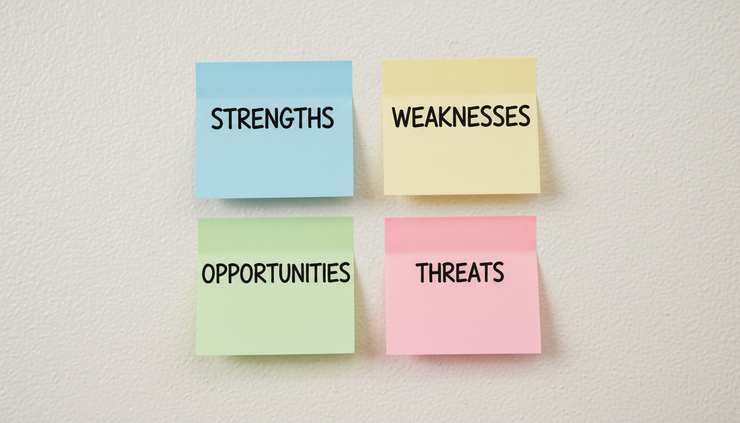
The four parts of SWOT analysis
Let’s understand each part with familiar Indian company examples.
Strengths show what the company does well
Strengths are the internal advantages of a company. These may include a strong brand, loyal customers, good technology, wide distribution, skilled employees, patents, cost advantage, or financial strength.
Tata example
Tata Group has a strong reputation in India. Many customers associate Tata with trust, quality, and long-term stability. This trust helps Tata companies in sectors like automobiles, steel, consumer products, and technology services.
Possible Tata strengths include:
strong brand trust across India
presence in many industries
long business history
access to talent and capital
experience in large-scale operations
In an exam answer, you should connect the strength to business impact. Do not just write “strong brand”. Write how it helps. For example, Tata’s brand trust can make customers more willing to try new products from the group.
Weaknesses show what needs improvement
Weaknesses are internal limitations. These are areas where a company may be less efficient, less competitive, or vulnerable.
A weakness is not always a failure. It simply shows where the company must improve.
Zomato example
Zomato is widely known for food delivery and restaurant discovery. Still, like many delivery platforms, it faces challenges around delivery costs, discounts, customer retention, and profitability pressure.
Possible Zomato weaknesses include:
dependence on delivery partners and restaurant partners
high competition in food delivery
pressure to balance customer discounts with profits
difficulty in maintaining service quality across cities
A good SWOT answer should avoid emotional judgement. Do not write “Zomato is bad at profits” unless the case data supports it. A better point is that food delivery platforms often face margin pressure because of delivery costs, offers, and competition.
Opportunities show where the company can grow
Opportunities are external chances that a company can use. They come from market trends, technology, customer behaviour, government policy, or gaps in competition.
Zomato example
India has a large young population, rising smartphone use, growing online payments, and increasing comfort with app-based services. These trends create growth opportunities for food delivery companies.
Possible Zomato opportunities include:
growth in tier 2 and tier 3 cities
rising demand for quick food delivery
more digital payments through UPI
partnerships with restaurants and cloud kitchens
use of data to improve recommendations and delivery planning
This is where many students can score well. Link opportunities to the Indian market. A SWOT analysis example India should reflect Indian consumers, cities, price sensitivity, local competition, and digital behaviour.

Threats show outside risks
Threats are external challenges that can hurt business performance. These may include new competitors, changing customer habits, new rules, economic slowdown, supply chain issues, or technology changes.
Tata example
Tata companies operate in many sectors, so threats vary by industry. Tata Motors, for instance, faces competition from Indian and global automobile companies. It also needs to respond to electric vehicle trends, changing fuel prices, and regulatory norms.
Possible Tata threats include:
strong competition in automobiles and consumer goods
rising input costs in sectors like steel and manufacturing
fast changes in electric vehicle technology
global economic uncertainty
regulatory changes in different industries
Threats are outside the company’s control, but the response is inside the company’s control. That is an important distinction in SWOT analysis BBA MBA answers.
A simple SWOT analysis template for students
Use this SWOT analysis template whenever you get a case study, company profile, or project topic.
SWOT element | Questions to ask | Your notes |
Strengths | What does the company do better than others? What resources does it have? | |
Weaknesses | Where is it struggling? What limits its performance? | |
Opportunities | What market trends can help it grow? What new customer needs exist? | |
Threats | What external risks can hurt it? Who or what can challenge it? |
Here is a quick way to use it:
Read the case once for the overall story.
Read it again and underline facts, not opinions.
Put each fact into one of the four boxes.
Separate internal points from external points.
Write short points with business impact.
End with a recommendation.
For example, if a case says a company has loyal customers, that is a strength. If it says raw material prices are rising, that is a threat. If online demand is increasing, that is an opportunity.
That is the basic method behind how to do SWOT analysis well.
Mini SWOT analysis of Zomato
Here is a simple student-style SWOT for Zomato:
Strengths | Weaknesses |
Strong consumer recall in food delivery | High pressure on delivery costs and margins |
Easy-to-use app and large restaurant network | Dependence on restaurants and delivery partners |
Strong presence in major Indian cities | Service quality can vary by location |
Opportunities | Threats |
Growth in smaller cities | Strong competition from other platforms |
More UPI and app-based payments | Changes in delivery regulations or labour rules |
Cloud kitchens and new food habits | Price-sensitive customers may reduce orders |
This is a clean SWOT analysis Zomato / Tata style answer because it is specific, balanced, and linked to business decisions.

How SWOT helps in exams and real business decisions
In exams, SWOT helps you structure answers quickly. Instead of writing random points, you can show the examiner that you understand internal and external analysis.
In case studies, SWOT helps you move from facts to strategy. Once you identify strengths, weaknesses, opportunities, and threats, you can suggest what the company should do next.
In real business decisions, SWOT helps managers think before acting. A company may use its strengths to capture an opportunity. It may fix weaknesses before entering a new market. It may prepare for threats before they become serious problems.
That is why SWOT remains popular. It is simple, but it forces clear thinking.
The next time you read about Tata, Zomato, Reliance, Amul, Infosys, or any other Indian company, try making a four-box SWOT. Keep the points short. Support them with facts. Then ask the most important question: “What should the business do next?”


.png)


Comments